Before you buy your first inventory: how much to order, and what to check first
Treat the first order as a test, not a launch. Before you pay a supplier, confirm the product already sells, know why buyers would pick yours, work out the landed cost and the margin after fees and ads, check the product rules, and choose one variant and one channel. Then order enough to cover your restock time at a cautious sales estimate, and write down in advance what result means go and what means stop.
The most expensive mistake a first-time seller makes is rarely the product idea. It is the first order: a thousand units of the wrong colour, a landed cost nobody worked out, or stock sitting in a warehouse while storage fees run.
Every question below can be answered on paper, before any money moves. That is the cheapest test there is.
Do you need inventory to start selling online?
Not always. Print on demand, made-to-order and pre-orders let you sell before you hold stock. But if you are building a brand around a physical product on Amazon, Walmart or your own store, you will need inventory sooner or later. The real question is how much, and what you should know before you buy it.
Seven decisions before you pay a supplier
- Does it already sell? Search demand, competitors with steady reviews, a trend that is rising rather than spiking. A product with no competition usually has no market.
- Why would anyone pick yours? Read the one- to three-star reviews of the top sellers. Your version has to fix something buyers complain about.
- What does it cost landed? The supplier’s price plus freight, duty, brokerage, packaging and prep.
- What is left after fees and ads? If the margin only works with no advertising, it doesn’t work.
- Is it allowed, and is it safe? Children’s products, batteries, cosmetics and anything that touches food can need testing first. In Canada, labels may need English and French.
- Which version, and which channel first? One variant, one channel, where demand is clearest.
- What happens if it doesn’t sell? Decide your way out, and the most you are prepared to lose, before you order.
What does one unit really cost?
Here is an illustrative product selling at C$34.99, with round numbers. The supplier quotes C$6.00. Freight, duty and brokerage, packaging and prep take the landed cost to C$9.00. The platform fee, fulfilment, the ad cost of each sale and a returns allowance take the rest:
Three warning signs: a landed cost above about a third of the selling price, profit per unit smaller than the ad cost per sale, or a margin that only works at a price above the top sellers’. If one unit doesn’t make money on paper, more units won’t fix it.
What’s inside the free guide
The decisions, a per-unit cost sheet you can fill in with your own quote, and a plan for sizing the first order.
- 01Why the first order is a test, not a launch
- 02Seven decisions before you pay a supplier
- 03Landed cost and real margin, line by line
- 04How many units to order, with an example
- 05Go, test small or stop: set the lines first
- 06Have the product checked before you pay
How much inventory should you buy for your first order?
Big enough to give you a real answer, small enough that a wrong answer doesn’t end the business. Work it out in five steps:
- Monthly sales, honestly. Take the lower estimate for similar listings and halve it. A new listing has no reviews yet.
- Time to restock. Production, shipping and warehouse check-in, in weeks.
- Units to cover it. Monthly sales times months to restock, plus a small buffer.
- The supplier’s minimum. Ask for a smaller first order at a higher unit price. Many factories agree.
- Cash tied up and the most you could lose. Units times landed cost, plus samples, photos and launch ads, minus what clearance would bring back.
In the example: similar sellers move about 300 a month, so plan on 150. Restocking takes about ten weeks, so 150 × 2.5 plus a buffer of 75 is 450 units. The factory’s minimum is 1,000, but it agrees to 500 at a slightly higher price. That ties up about C$6,000 in all, with a worst case of around C$4,000 if clearance brings back C$2,000.
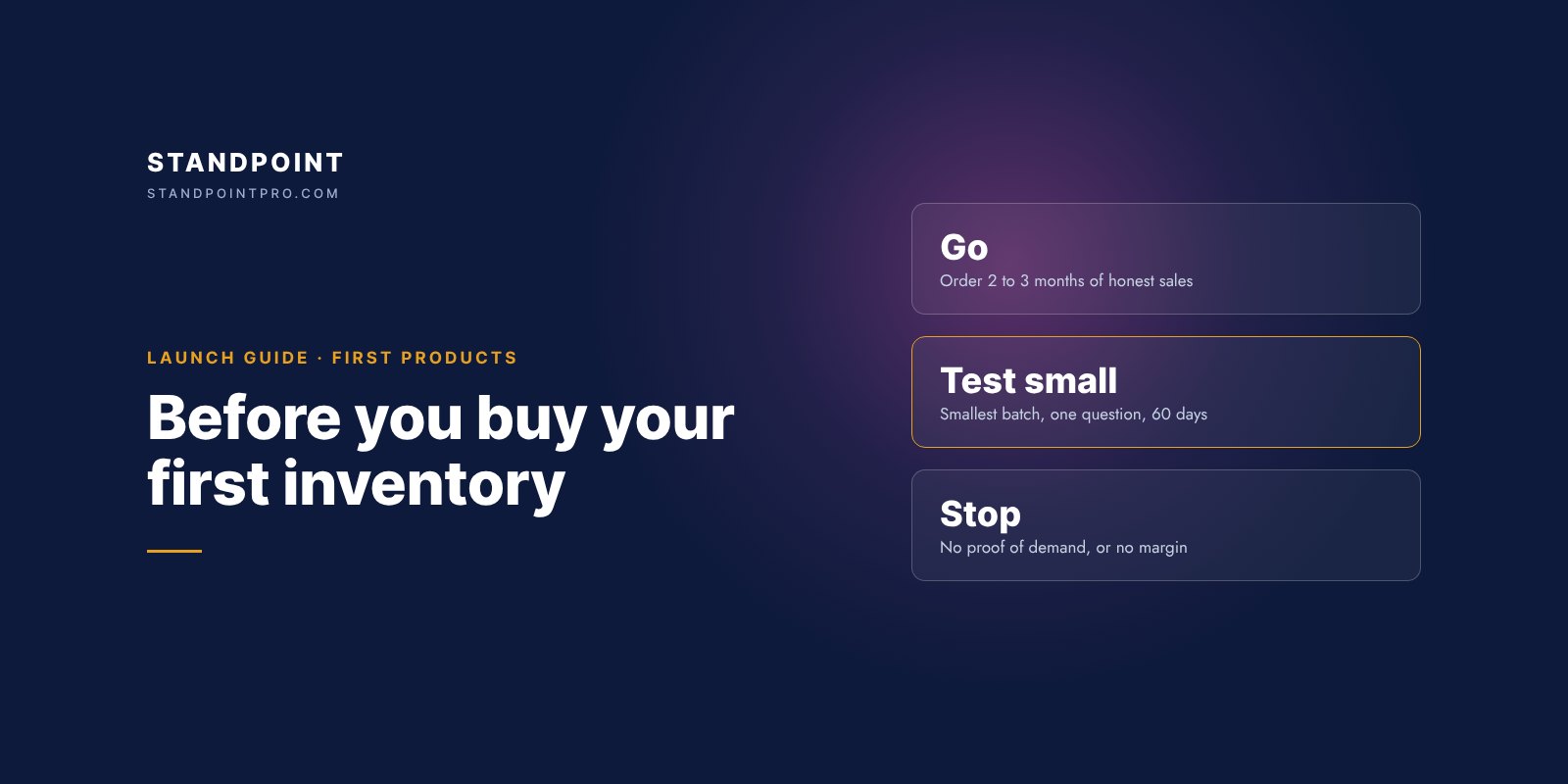
Go, test small or stop
Write down your lines before you order, not after the stock arrives.
- Go: all seven decisions answered with evidence and a margin that survives ad costs. Order two to three months of the honest sales estimate.
- Test small: demand is real but one answer is weak. Buy the smallest batch the supplier accepts, with one question, one target and a 60-day deadline.
- Stop: no proof of demand, no margin, or a safety question you can’t answer. The next product will cost less than this loss.
Have the product checked before you pay for it
You can work through all of this on your own. If you would rather have it answered with real data before any money leaves your account, that is what our product analysis does: demand and search trends, competitors and their reviews, landed cost and margin channel by channel, safety and marketplace flags, and a clear verdict with a first-order size. It costs far less than a first order that goes wrong.
See the format in our free analyses of a UV-C toothbrush sanitizer holder and food squishies, or book a free call and bring your product link or supplier quote.
Questions first-time sellers ask
How much inventory should I start with for an online store?
Enough to cover your restock time at a cautious sales estimate, plus a small buffer. For most first products that means a few hundred units of one variant, not thousands across many.
What is a good minimum order quantity for a first order?
One you can sell within two to three months and could afford to lose. Many factories accept a smaller first order at a higher unit price, so ask for that price in your request for quote.
What is landed cost?
Everything it takes to get one unit into the warehouse you sell from: the supplier’s price plus freight, duty, brokerage, packaging, labels, prep and delivery.
What profit margin should a new product have?
There is no single number, but the profit left after platform fees, fulfilment, returns and ad costs has to carry the product while the listing earns its first reviews. If profit per unit is smaller than the ad cost of a sale, treat it as a warning.
Should I sell on Amazon or my own store first?
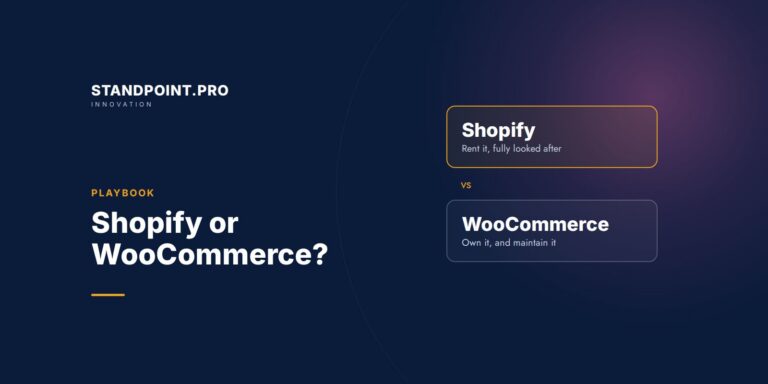
Start where demand for your product is clearest, usually one channel. Our guides on Amazon.ca or Amazon.com and Shopify or WooCommerce help with that choice.
What does a Standpoint product analysis include?
Demand and search trends, competitors and what their reviews say, landed cost and margin by channel, safety, labelling and marketplace flags, and a clear verdict with a first-order size, walked through with you on a call.
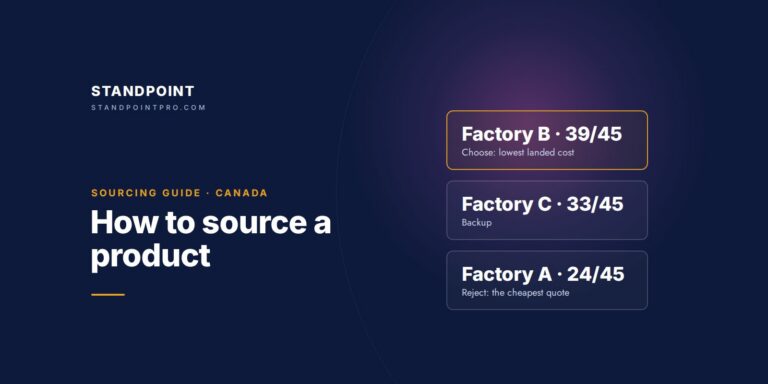
Ready to find the factory? Read how to find a manufacturer for your product, or see how we launch a new online business with you.
Want this applied to your business? Start with a strategy call →
15 minutes. Free. No pitch.
Get the free guide
6-page PDF · Free · Opens right after.
Your details stay with us. No newsletter unless you tick the box.