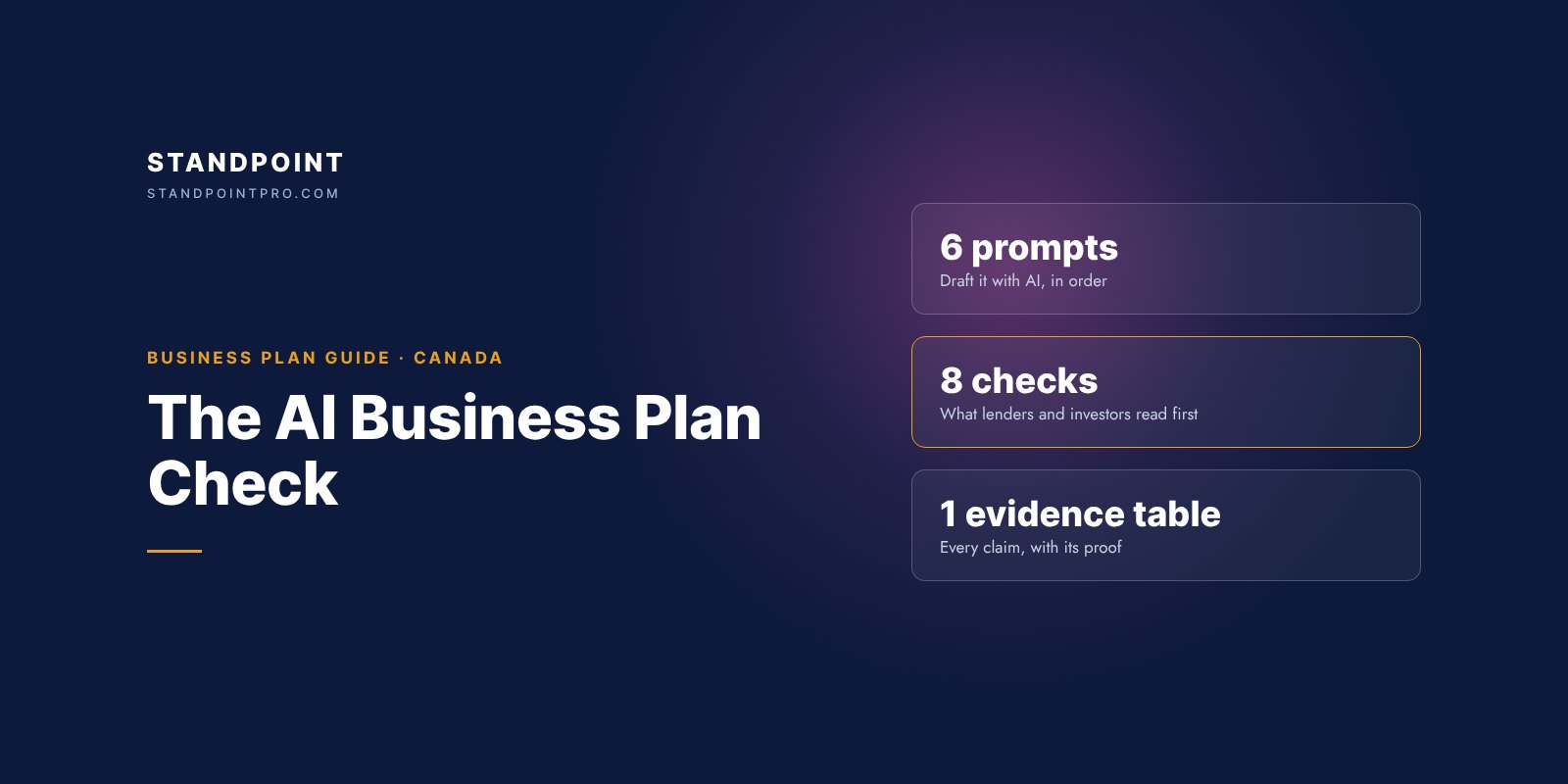
How to write a business plan with AI that lenders and investors will trust
Use AI to interview you, structure the plan and build a forecast from drivers, then check it the way a reader will: a specific customer, demand you can show, a market built from the bottom up, a price that covers costs, numbers tied to drivers, monthly cash, an exact ask and a team that can deliver. AI may write the sentences. Every fact has to come from you, your tests or a source you can name.
AI can turn a rough idea into a forty-page business plan before lunch. It will have a market size, a competitor table and a revenue line that climbs neatly every month. It will also, very often, be wrong in ways a banker or investor spots in the first five minutes.
This is how we use AI on business plans with founders: as a fast drafter and a tough critic, never as a source of facts.
Can you use AI to write a business plan?
Yes, for the parts AI is good at: asking you the right questions, organizing your thinking into sections, drafting and rewriting, and attacking the plan the way a sceptical reader would. It saves days of blank-page time.
No, for the facts. AI tools state market sizes, growth rates and competitor figures with full confidence, whether or not a source exists. A lender doesn’t mind that you used AI. They mind a plan that doesn’t hold up, and an owner who can’t explain where a number came from.
Six prompts, in order
Use any AI chat tool, such as ChatGPT, Claude or Gemini, and keep everything in one conversation so each step builds on the last.
- Make it interview you first. Ask for 15 questions, one at a time, about the customer, the offer, price, competitors, costs, your experience and how much money you need, before it writes anything.
- Define the customer and the reachable market. One paragraph on the customer, then how many of them you can realistically reach in two years, built from the bottom up, with every assumption listed.
- Map the alternatives. What the customer uses today instead of you, including doing nothing, and what would make them switch.
- Build the numbers from drivers. A 24-month monthly forecast where revenue comes from customers, price and frequency, with low, base and high values for each assumption.
- Turn it against yourself. Ask it to act as a lender and list the ten weakest points, ranked by how likely each is to get the plan declined.
- Rewrite the summary in plain words. Under 250 words, no buzzwords, every number matching the forecast.
The full wording of each prompt is in the free guide, ready to paste.
What do lenders and investors check first?
Readers rarely start at page one. They go straight to the places that tell them whether the rest is worth reading:
- A specific customer: a defined group, not “everyone who wants…”.
- Demand shown, not stated: pre-orders, a waitlist, letters of intent or pilot sales.
- A reachable market: customers you can reach times what they pay, not 1% of a billion-dollar industry.
- A price that covers costs: margin after direct costs, payment fees, shipping and returns.
- A forecast tied to drivers: growth with a reason, not a straight line rising every month.
- Cash, not just profit: monthly cash flow and the lowest cash month.
- An exact ask: how much, for what, how long it lasts, and what you put in yourself.
- People who can deliver: relevant experience, who does what, and how gaps are filled.
And one quiet killer: a revenue figure in the summary that doesn’t match the forecast. It tells the reader the plan was assembled, not thought through.
What’s inside the free guide
The prompts, the checks and an evidence table, on pages you can print and work through with your draft open.
- 01Why a fluent AI plan is not a plan that holds
- 02Six prompts, in order, ready to paste
- 03The eight checks lenders and investors make first
- 04What a bank reads closely, and what an investor reads
- 05The evidence table, with a worked example
- 06Where Canadian evidence comes from
A plan for a bank, or a plan for an investor?
The facts are the same; the emphasis changes. A bank, or a lender such as BDC or Futurpreneur, asks whether the business can repay from its own cash flow, what security and personal contribution there are, and whether the forecast is cautious. It reads the price, the cash flow and the ask most closely.
An investor asks how large this can become, why this team, and how the money turns into growth. It reads the demand, the market and the people most closely, and still expects the cash to make sense.
How do you prove demand before you launch?
List every claim your plan depends on, and next to each one write the evidence you have, its source and how strong it is. Your own data and official sources are strong. Someone else’s general figure is weak. An assumption with nothing behind it is a test you still have to run.
Evidence you can create in a few weeks: a landing page with a waitlist or pre-order, ten written-up conversations with real buyers, a small paid pilot, and supplier quotes in writing for your main costs. For market figures, Statistics Canada publishes population, household spending and business counts by industry and size.
Common mistakes in AI-written business plans
- Market statistics copied from a chat with no original source.
- A top-down market size (“if we get 1%…”) instead of customers you can actually reach.
- Revenue that rises by the same percentage every month.
- A yearly profit figure with no monthly cash flow.
- A competitor table that leaves out the most common alternative: doing nothing.
- Numbers that differ between the summary, the forecast and the ask.
- Words like innovative, revolutionary and disruptive doing the work evidence should do.
Questions founders ask
How long should a business plan be?
For most small businesses applying for a loan, 10 to 20 pages plus a financial forecast is enough. A short plan whose numbers agree everywhere beats a long one. Investors often start with a pitch deck and ask for the plan later.
Do banks accept business plans written with AI?
Lenders judge the content, not the tool. What matters is that you can explain and defend every number. If AI wrote the plan and you can’t, it shows in the first conversation.
What should the financial section include?
A monthly forecast for at least the first 12 to 24 months: revenue built from customers and price, direct and fixed costs, cash flow and the lowest cash month, with the assumptions behind each line listed separately.
Where can I find market data for a business plan in Canada?
Statistics Canada for population, households and business counts; your province’s small business centre; industry associations; and your own tests, such as pre-orders or pilot sales, which are often the strongest evidence of all.
Do I need to register or incorporate before writing the plan?
No. You can write and test the plan first. Registration, incorporation and tax setup are questions for your accountant or lawyer, and the right structure often depends on what the plan shows.
Can Standpoint write my business plan?
We build plans and financial models with founders, not for them: we test the idea against real demand, build the numbers from drivers and prepare the documents a lender, investor or partner will ask for. You stay able to defend every line.
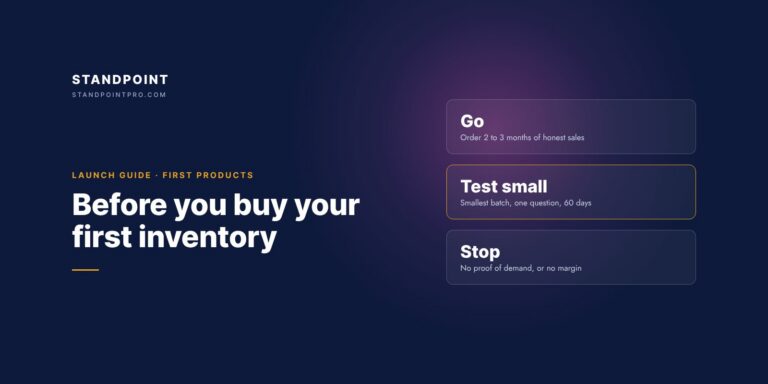
Want help with yours? See our startup and business advisory service, or if your plan involves a physical product, read before you buy your first inventory.
Want this applied to your business? Start with a strategy call →
15 minutes. Free. No pitch.
Get the free guide
6-page PDF · Free · Opens right after.
Your details stay with us. No newsletter unless you tick the box.