How to find a manufacturer for your product: a step-by-step sourcing guide
Find candidates on B2B marketplaces, at trade fairs and through referrals, send every factory the same written request for quote, then check samples, the business licence and a live video tour before any money moves. Score each factory on nine criteria, starting with the landed cost per unit, not the quoted price. Reject on any red flag about payment or identity.
You have a product. Now you need someone to make it, and you are about to send a deposit to a company on the other side of the world. This is the step where most new brands lose money: not on the idea, but on the factory.
This is how we find manufacturers, compare their quotes and check them before any money moves. It is the same process we run for clients, with a worked example of three factories quoting one product.
How do you find a manufacturer for your product?
Start wide, then cut hard. For each product we build a list of 10 to 20 candidates, send a request for quote to the best 5 to 8, and usually sample three. The candidates come from five places, each with its own job:
- B2B marketplaces such as Alibaba, Made-in-China and Global Sources. Fast for a first list and for comparing prices. Many listings are trading companies, and a “verified” badge is a paid service, not proof of quality.
- 1688, China’s domestic marketplace. Often closer to factory price, but in Chinese and usually needs a local agent.
- Trade fairs such as the Canton Fair. You meet owners, handle real samples and compare many suppliers in a day.
- Referrals from importers in the same category. The fastest route to a factory someone already trusts.
- Sourcing agents. Local language and quality control on the ground. Ask who pays them, and who owns the supplier relationship.
Factory or trading company: how to tell the difference
A trading company is not always a problem, but it adds margin and puts a layer between you and production. You should know which one you are dealing with. A real factory usually has a business licence with manufacturing in its scope, a narrow product range, and will show you the production line on a live video call. A trader tends to list hundreds of unrelated products, holds a licence for trading and import-export only, and takes video calls from an office.
What to put in a request for quote
If every factory quotes a different spec, quantity and delivery term, you can’t compare them. A good request for quote (RFQ) fixes that. Send the same one to every factory, in writing, and include:
- The product spec: size, weight, materials, colours and tolerances.
- Packaging: retail box, cartons and barcode labels.
- The certifications and test reports your market requires.
- Prices at two or three quantity tiers, to see where the real minimum order sits.
- One Incoterm for everyone: FOB (loaded on the ship) or EXW (collected from the factory).
- Sample cost and lead time, and whether the sample fee is refunded on order.
- Production lead time, payment terms, private-label options, and the company’s business licence.
How to vet a supplier before you pay a deposit
We score every factory on nine criteria, five points each, for a total out of 45. It is the same scale we use for our product analyses, so a product and its factory are judged the same way.
- Landed cost per unit, not the quoted price.
- MOQ fit for a first order you can sell in three to four months.
- Lead time and reliability, including whether sample dates were met.
- Sample quality against the written spec.
- Factory verification: licence, live video tour or third-party audit, export history.
- Compliance and certifications for the rules your product falls under.
- Communication: clear written answers within a working day.
- Payment terms and buyer protection, with the bank account in the company’s own name.
- Capacity to scale and customize, including private label and packaging.
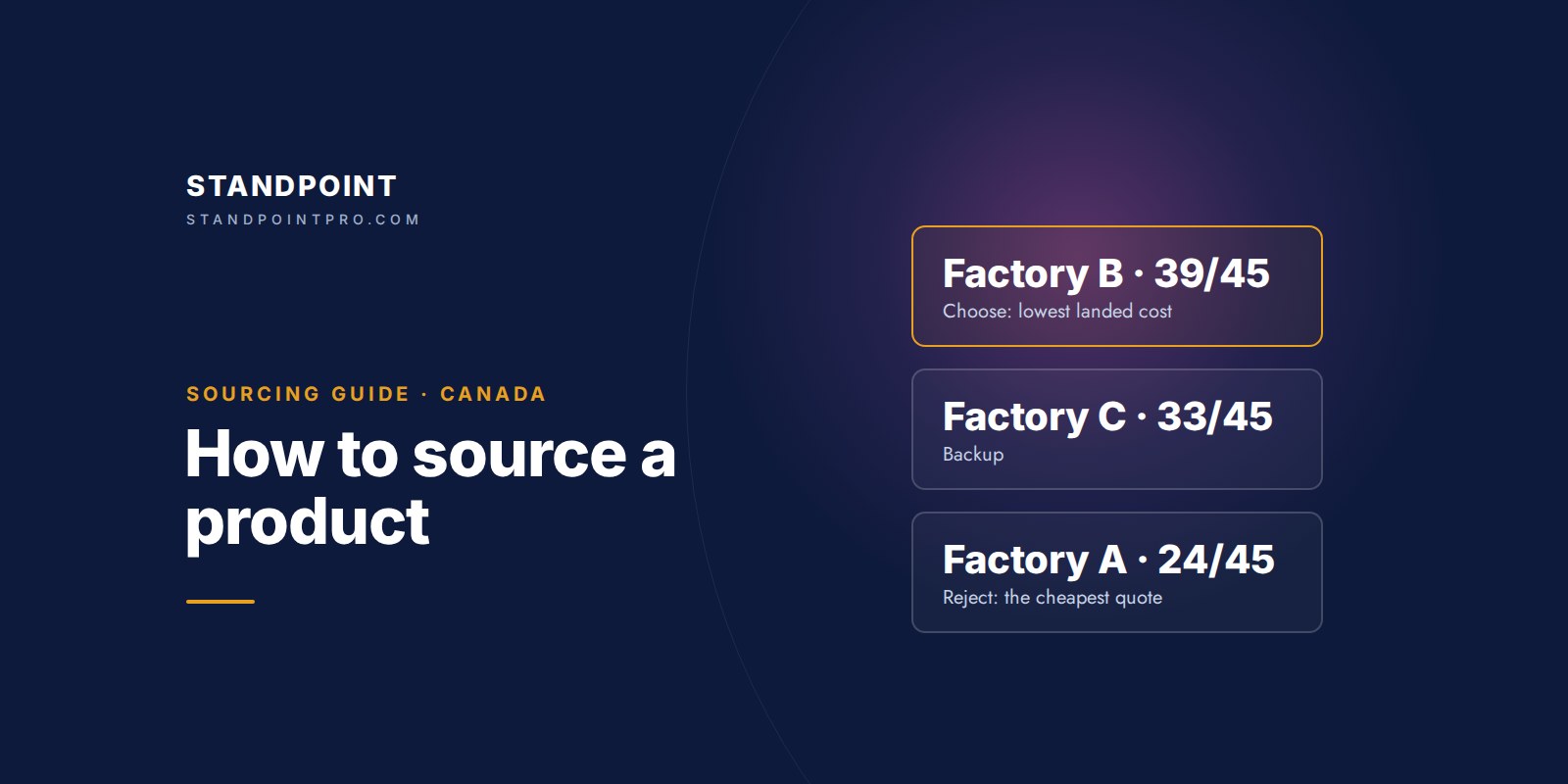
36 or more means choose, 27 to 35 means backup, under 27 means reject. Two knock-out rules come first: a factory that fails verification or can’t meet the compliance rules for your product is rejected whatever its total. So is any factory that hits a “stop” red flag. A fast no costs one email; a deposit you can’t get back costs far more.
Red flags that mean stop
Any one of these and we walk away, with no score needed:
- The bank account is in a different name from the company on the licence and the contract.
- Bank details change by email. This is a classic fraud; confirm any change on a video call before paying.
- The business licence doesn’t match the company quoting you.
- No live video tour of the production line. Photos and old videos don’t count.
- Test reports never arrive, or they are for a different product.
- Pressure to pay outside the platform’s protected payment in exchange for a “discount”.
Other warning signs, such as asking for 100% upfront, a price far below everyone else, or vague answers on materials, are worth a written question. If two of them aren’t fixed, the factory is out.
How we check, in practice
Verification doesn’t need a plane ticket for most first orders. We ask for a copy of the business licence and match the company name and business scope to the quote, the contract and the bank account. We book a live video tour at short notice, on the line that makes our product, and ask to see raw material, a machine running and finished stock. We read every test report for the product, material, colour and date. For larger orders, a third-party factory audit costs less than one bad shipment.
A worked example: three factories, one product
To show the method, here is one typical private-label product followed from quote to warehouse: a five-piece silicone kitchen utensil set, sold on Amazon.ca, first order 1,000 sets, retail price C$29.99. The numbers are illustrative round figures, built to show how the decision works.
| Factory A · China | Factory B · China | Factory C · Vietnam | |
|---|---|---|---|
| Quoted price per unit | C$4.40 (EXW) | C$5.00 (FOB) | C$5.40 (FOB, at 2,000) |
| MOQ | 500 | 1,000 | 2,000 |
| Payment terms | 100% upfront | 30% / 70% | 30% / 70% |
| Landed cost per unit | C$7.56 | C$7.18 | C$7.35 |
| Score | 24/45, reject | 39/45, choose | 33/45, backup |
On paper Factory A wins: 12% cheaper than Factory B and the lowest minimum order. Then the checks started. Its quote was ex-works, so trucking and export clearance were extra, and a weak sample means a defect allowance and stricter inspection: C$7.56 landed against Factory B’s C$7.18. Three of ten samples failed, it declined a live video tour, and the bank account was in a different company’s name. That last one is a stop flag on its own. Factory C was strong, though its test reports covered a different colour and must be redone, and it needed 2,000 units, too many for a first order, so it became the backup. Factory B, the middle quote, had the lowest landed cost and the only paperwork that fully matched the product.
The next step with Factory B is a pre-production sample, the 30% deposit, and an inspection booked before the 70% balance is paid. That last step matters most: once the balance is paid, your leverage is gone, so the inspection has to happen while the money is still yours.
What’s inside the full guide
Three factory quotes, the 45-point scorecard and the landed cost sheet, for founders about to choose a manufacturer.
- 01Why the cheapest quote is rarely the cheapest factory
- 02Where we find factories, and how to spot a trader
- 03The request for quote we send, line by line
- 04The scorecard: nine criteria, knock-out rules
- 05Worked example: quotes, samples, checks and scores
- 06Landed cost in Canada, step by step
- 07The Canadian import checklist and product rules
- 0812 red flags before you pay a deposit
- 09From sample to shipment, and China or a second country
What does a product really cost to land in Canada?
Landed cost is everything it takes to get one unit from the factory into the warehouse you sell from. In the example, Factory B’s C$5.00 quote becomes C$7.18:
- Factory price, FOB port: C$5.00
- Sea freight to Canada: C$0.60
- Duty (example rate of 6.5%): C$0.33
- Customs broker and fees: C$0.15
- Pre-shipment inspection: C$0.30
- Amazon FBA prep and inbound: C$0.80
GST is also paid at the border, but a GST-registered business can usually claim it back, so treat it as cash flow rather than cost. Your duty rate depends on the product’s HS code and its country of origin; goods that qualify under a trade agreement, such as CPTPP for Vietnam, may enter at a lower rate.
Two rules catch many first-time importers. Commercial importers need their own Business Number with an import-export account and a CARM Client Portal account, and can no longer import under their broker’s number. And to get goods released before paying duties and taxes, you must post your own financial security in CARM. Some products also carry their own rules on top of customs: toys and children’s products, cosmetics, electronics and batteries, and anything that touches food. Bilingual English and French labelling applies to most consumer goods. Write the rules your product must meet into the purchase order, and tie the balance payment to the test reports and the inspection. Rules checked as of October 2026; confirm current requirements with the CBSA or a licensed customs broker.
Should you source from China or somewhere else?
China is still the fastest place to find a capable factory for most products, with the widest range and quick sampling. But a second country gives you a backup and sometimes a lower duty. From our own sourcing: Vietnam suits furniture, textiles and footwear, with possible CPTPP savings; India suits home textiles, cotton and leather; Turkey suits towels, apparel and ceramics, often in smaller runs at higher quality. Expect higher minimum orders and longer lead times outside China. Our rule: China first, rarely China only.
Questions founders ask
How much does it cost to make a product sample?
For a simple existing product, usually tens of dollars plus courier shipping, and many factories refund the fee when you order. Custom samples that need new tooling or moulds cost much more, so ask for the sample price in your request for quote.
What MOQ should a first order have?
Enough stock to sell for three to four months, and no more than you can afford to lose if the product underperforms. Prices at several quantity tiers help you find the balance.
Is Alibaba safe for finding a manufacturer?
It is a good place to find candidates, not a guarantee. Verify every supplier yourself: licence, live video tour, test reports, and payment to an account in the company’s own name, ideally through the platform’s protected payment.
Do I need a customs broker to import into Canada?
It isn’t mandatory, but most small importers use one for their first shipments. You remain the importer of record and stay responsible for duties, taxes and correct declarations either way.
How long does it take from first quote to stock in the warehouse?
For a new product with a new factory, by sea from Asia, plan on 12 to 20 weeks. Reorders with a proven factory are faster.
Who owns the supplier relationship when Standpoint sources for me?
You do. The factory, the contracts and the contacts are yours from day one.
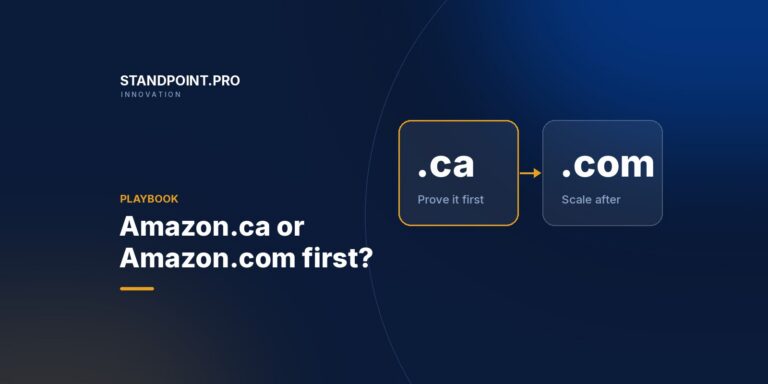
Want us to run this for your product? See our product sourcing and brand launch service, or read our comparison, Amazon.ca or Amazon.com first?, and our UV-C product analysis.
Want this applied to your business? Start with a strategy call →
15 minutes. Free. No pitch.
Get the free guide
16-page PDF · Free · Opens right after.
Your details stay with us. No newsletter unless you tick the box.