Elon Musk’s next 10 years: 4 predictions, and what the numbers say
Elon Musk has a habit of describing the future in numbers. Over the past two years he has laid out what he thinks the world looks like by about 2036: at the G20 Innovation Ministerial in September 2026, in an interview with The Economist in July, on podcasts and in a post on X this month. Here are his four biggest predictions in one place, with the data that puts each one in context.
The short answer
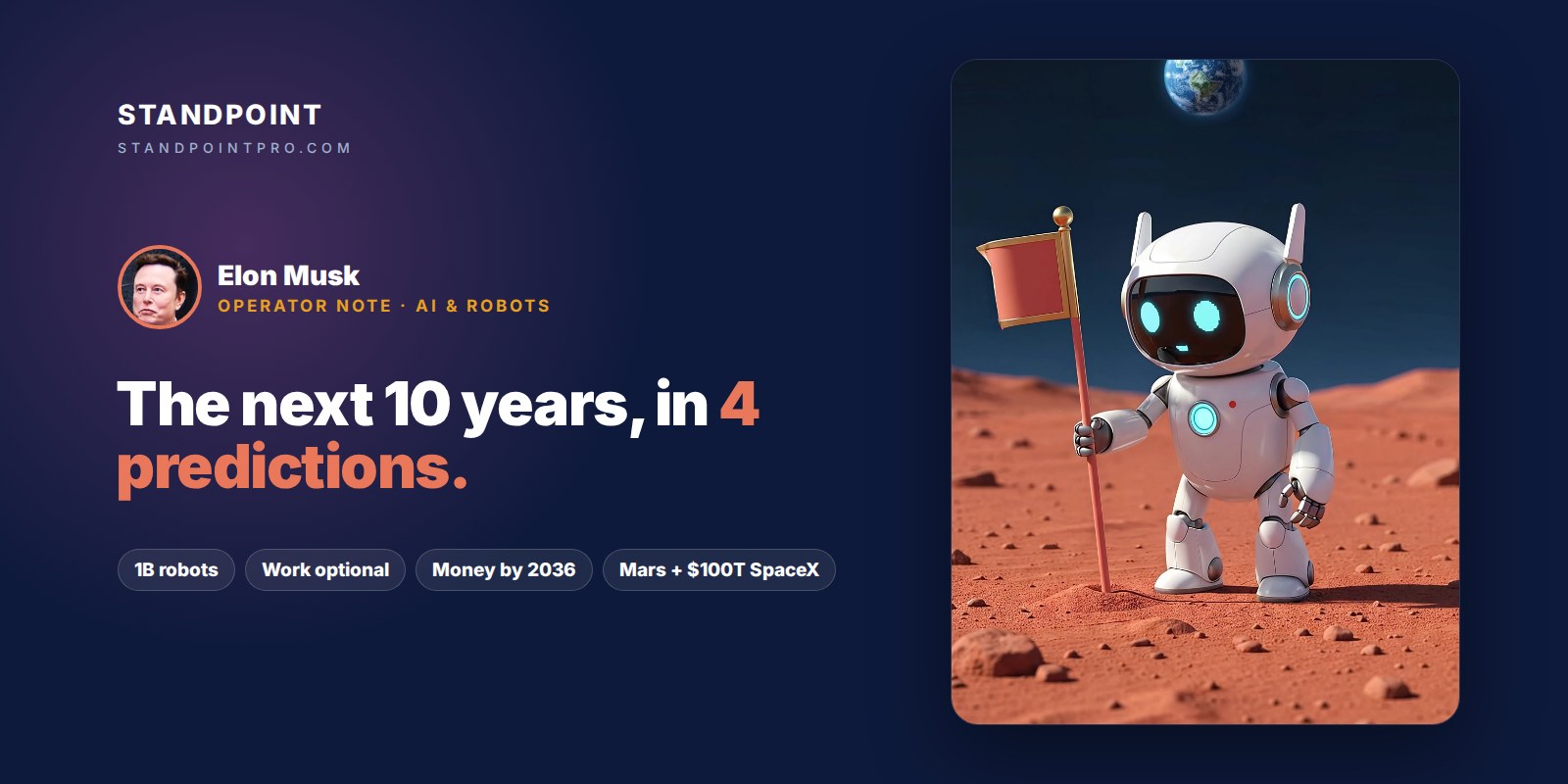
- Robots: well over a billion humanoid robots within ten years, each about five times as productive as a person.
- Work: optional within 10 to 20 years.
- Money: “won’t matter in 2036.”
- Space: humans on Mars within ten years, and SpaceX worth more than $100 trillion.
1. Over a billion humanoid robots
Speaking by video to the G20 Innovation Ministerial on 1 September 2026, Musk said: “Ten years from now, I would say there are well over a billion humanoid robots.” He estimated each would be about five times as productive as a human, which would make the fleet more productive than all people combined.
The data: about 19,100 humanoid robots were shipped worldwide in the first half of 2026. At that pace, a billion would take roughly 26,000 years; Musk’s forecast needs production to grow by several orders of magnitude. At the same event he said AI alone could add 20–30% to global output, about $20–30 trillion a year, before robots add more.
2. Work becomes optional
In an interview with Zerodha co-founder Nikhil Kamath, Musk said: “My prediction is, in less than 20 years, working will be optional,” and suggested it could come in 10 to 15 years. The reasoning: if AI and robots produce most goods and services, people work because they want to, not because they have to.
The nearer-term version: at the G20 he also said AI would reach “Stockfish-level” software coding (far beyond any human, like the chess engine) within 12 to 18 months, and handle any digital task that does not need hands by the end of 2027. Those are the claims to watch first, because they are close enough to check.
3. Money won’t matter by 2036
In his July 2026 interview with The Economist, Musk said: “Money won’t matter in 2036.” He expects AI and robots to create so much abundance that people receive a “universal high income”. His question: “What do you want money for?” if goods and services are cheap and plentiful.
This is the boldest of the four, because it depends on the first two coming true at scale, and on how the gains are shared, which he did not set out in detail.
4. Humans on Mars, and a $100 trillion SpaceX
On the Lex Fridman podcast Musk put humans on Mars at “best case about five years, worst case ten years,” with Starship as the main remaining challenge. On 15 October 2026 he posted on X: “Unless there is a major world war, SpaceX probably gets to >$100T in <10 years.”
The data: SpaceX went public on 12 June 2026 in the largest listing ever and was worth about $2.0 trillion at the close on 23 October. $100 trillion means growing about 50 times in under a decade.
His track record
Musk is often right about the direction and usually wrong about the date. In 2016 he said a Tesla would drive itself across the US by the end of 2017; fully unsupervised self-driving has been promised as “next year” many times since. The useful way to read these predictions is as a direction of travel, not a schedule.
What it means for a small business
Every one of these forecasts points the same way: the cost of work is falling, digital work first and physical work later. You do not need to believe in 2036 to act on the first step.
- List the repeating work. Inbox, follow-ups, bookings, invoices, listings. That is what AI agents take over first.
- Test one job. One agent, one app, four weeks, with a clear before-and-after. See what a small business run with AI agents looks like.
- Watch your sales channels. AI is starting to shop too: Walmart is about to let AI assistants buy for customers.
If you want help picking the first job to hand over, start with a strategy call.
Common questions
What did Elon Musk predict for the next 10 years?
Four things: well over a billion humanoid robots within ten years, work becoming optional within 10 to 20 years, money no longer mattering by 2036, and humans on Mars with SpaceX worth more than $100 trillion within ten years. He made these predictions between 2024 and October 2026, at the G20 Innovation Ministerial, in an interview with The Economist, on podcasts and on X.
How many humanoid robots does Elon Musk predict?
“Well over a billion” within ten years, each about five times as productive as a person. He said this by video at the G20 Innovation Ministerial on 1 September 2026. For scale, about 19,100 humanoid robots were shipped worldwide in the first half of 2026.
When does Elon Musk say work will be optional?
In less than 20 years, and possibly within 10 to 15, according to his interview with Zerodha co-founder Nikhil Kamath. His argument is that AI and robots will produce most goods and services, so people will work by choice.
What did Elon Musk say about money in 2036?
“Money won’t matter in 2036,” he told The Economist in July 2026. He expects AI and robots to create so much abundance that people receive a “universal high income” rather than losing out.
What is SpaceX worth today, compared with Musk’s $100 trillion prediction?
SpaceX listed on 12 June 2026 and was worth about $2.0 trillion at the close on 23 October 2026. Musk’s prediction of more than $100 trillion within ten years would mean growing about 50 times.
Are Elon Musk’s predictions usually right?
The direction is often right; the dates usually slip. In 2016 he said a Tesla would drive itself across the US by the end of 2017, and fully unsupervised self-driving has been promised as “next year” many times since. Read his timelines as a direction, not a schedule.
Checked 28 October 2026. Quotes are as reported by the sources below; predictions are Elon Musk’s, not Standpoint’s.
Sources: IBTimes: Musk’s G20 predictions and robot shipments, Fortune: when work becomes optional, ThisDay: “Money won’t matter in 2036”, Yahoo Finance: SpaceX “>$100T in <10 years”, CNBC: SpaceX IPO tops $2 trillion, StockAnalysis: SPCX market cap, Moneywise: Musk’s track record
Want one short note like this a month?
Practical notes on AI, e-commerce and growth, from businesses we run. No spam. Unsubscribe anytime.