Why AI Can’t Replace You: The Circle Test
Short answer: AI can’t replace you because it can only make what a prompt describes, and a prompt describes the average. Ask a million people for a circle and the model draws the same circle a million times. Your value has moved from the quality of the output to the choices behind it: which circle, and why. Perfect is now the cheapest thing on the market. A point of view is not.
The circle test
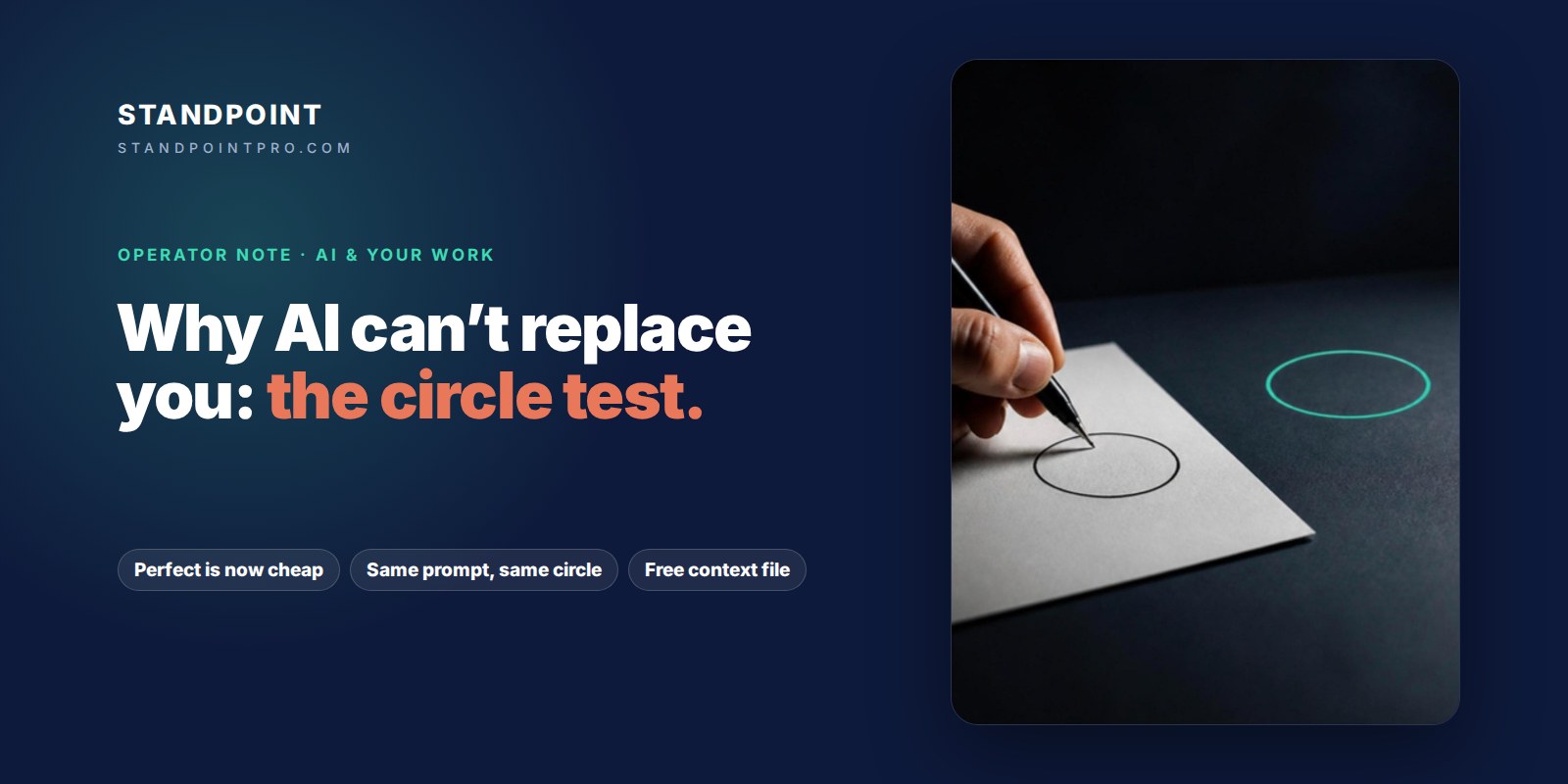
Ask a person to draw a circle. It comes out crooked, because the hand shook. It leans, because the mind was somewhere else. It doesn’t close, because they rushed the end.
Ask an AI to draw a circle. Clean. Fast. Flawless. Now ask a million people to send the same prompt. They all get the same circle.
That is the whole test. No model, with any prompt, will ever draw exactly the crooked one. Not even you, if you try again. The perfect circle is free and endless. The crooked one is the only thing in the room that can’t be copied.
Perfect is now the cheapest thing there is
For most of history, “perfect” was expensive. It took years of practice, or a team, or both. That is why a clean result used to be worth paying for.
Generative AI changed the price. A polished paragraph, a clean design, a correct answer now costs seconds, and the same seconds for everyone. When everybody can have perfect, perfect stops being a reason to choose you.
There is data on what happens next. In a 2024 study published in Science Advances, researchers at UCL and the University of Exeter had 300 people write short stories, some with no AI help and some with one or five story ideas from ChatGPT. The AI-assisted stories were rated better: about 8% more novel and 9% more useful, with the biggest gains for the least creative writers (about 11% on both). But stories written with an AI idea were also about 11% more similar to each other. Everyone got better, and everyone got closer to the same story. The authors called it an emerging social dilemma: the more each person leans on the model, the less the group has to say.
That is the circle again, at scale. Individual output goes up. Collective difference goes down.
Where your value went
It didn’t disappear. It moved.
- From the output to the intent. Anyone can get the circle. The question is which circle, for whom, and why now. That is a decision, and the model doesn’t make it.
- From polish to taste. AI can give you ten good options. Picking the right one, and knowing why the other nine are wrong, is still yours.
- From the work to the thinking behind it. A model can copy what you made. It can’t copy the years of “no” that made you make it that way.
- From the average to the signature. The crooked parts of your work, the opinions, the phrasing, the things you refuse to do, are no longer flaws to polish out. They are the only parts that can’t be downloaded.
What this means for a small business
- Stop competing on polish. If your pitch is “we do it cleanly,” a free tool now does it cleanly. Compete on judgment: what you’d tell a customer not to buy.
- Write your decisions down. Your rules of thumb, your voice, the things you’d rather lose than compromise. If they’re only in your head, AI can’t use them and neither can your team.
- Let AI draw the circle. Use it for the perfect, repeatable parts: the first draft, the clean-up, the format. Keep “which circle and why” for yourself.
- Give the model your context, not just your prompt. A prompt is one request. Context travels with every request. That is what the file below is for.
Not sure where AI fits in your business? Read what a small business that runs with AI agents looks like, pick a tool with Which AI matches you?, or book a short call and we’ll tell you honestly where it helps and where it doesn’t.
The Signature context file (free download)
In the video we promise a file. Here it is.
The Signature context file is one page that gives AI your identity. Paste it at the top of a chat, or save it where your AI keeps standing instructions (custom instructions, a project, saved info), and from then on the output is a version of you instead of the average of everyone.
It has eight sections: who I am, what I’m known for, how I decide, my voice, my taste, my audience, my non-negotiables, and my signature: two paragraphs of your own writing, which teach the model more than any rule. Each section is two or three lines, with a worked example.
The rule for using it: when an output sounds like everyone else, don’t fix the output. Fix the file. Add the rule it broke, then run it again.
Common questions
Will AI replace me?
It will replace the parts of your work that a prompt can describe: clean, standard, repeatable output. It can’t replace the choices behind the work, because the model doesn’t know your customer, your taste or your reasons. The more your job is judgment, the safer it is.
What is a context file for AI?
A short document that tells an AI who is asking: your role, audience, voice, rules and examples of your work. You paste it at the start of a chat or save it as a standing instruction. It changes what the model treats as the “most likely” answer, from the average of everyone to a version of you.
Does AI make everyone’s work sound the same?
The evidence says yes, at the group level. In a 2024 Science Advances study, stories written with AI ideas were about 11% more similar to each other, even though each one was rated better on its own. Individual quality rises; collective variety falls.
How do I make ChatGPT, Claude or Gemini write like me?
Give it context, not adjectives. “Write in a friendly tone” produces the average friendly tone. Two paragraphs you actually wrote, plus your rules (sentence length, words you never use, who you’re talking to), produce your tone. That is section 08 of the Signature context file.
Is “perfect” still worth paying for?
Less and less. A polished result is now close to free, so it can’t be the reason a customer chooses you. What people keep paying for is the decision: which option, for them, and why.
What is the circle test?
A 60-second comparison: a person draws a circle, then an AI does. The AI’s circle is perfect and identical for everyone who asks. The person’s circle is imperfect and impossible to repeat, even by the same person. It shows where value sits in the age of AI: not in the perfect output, but in the one trace only you can make.
Checked 29 October 2026.
Sources
- Doshi, A. R. & Hauser, O. P. (2024). Generative AI enhances individual creativity but reduces the collective diversity of novel content. Science Advances, 10(28).
- University of Exeter: AI found to boost individual creativity, but results in less varied content (July 2024).
- ScienceDaily: summary of the study (16 July 2024).
Want one short note like this a month?
Practical notes on AI, e-commerce and growth, from businesses we run. No spam. Unsubscribe anytime.