Tesla’s AI learned to use a computer. Here’s how it works
This week Tesla flew a car. On 15 October the new Roadster hopped over a Cybertruck on compressed-air thrusters, and that clip is everywhere. Five days earlier, a much quieter Tesla update went out: its AI had learned to use a computer by looking at the screen.
The car is a show. The second story is a technical shift worth understanding, because the same idea is already arriving in the software small businesses use every day.
The car, in three facts
- How it lifts: 10 cold-gas thrusters fed by about 600 litres of compressed air. SpaceX hardware in a car.
- What it did: short hops over other Teslas, a drive up a vertical ramp, a spin and a landing. Hops, not sustained flight.
- When: production is planned for 2028. The demo car was a prototype.
The AI news: Digital Optimus
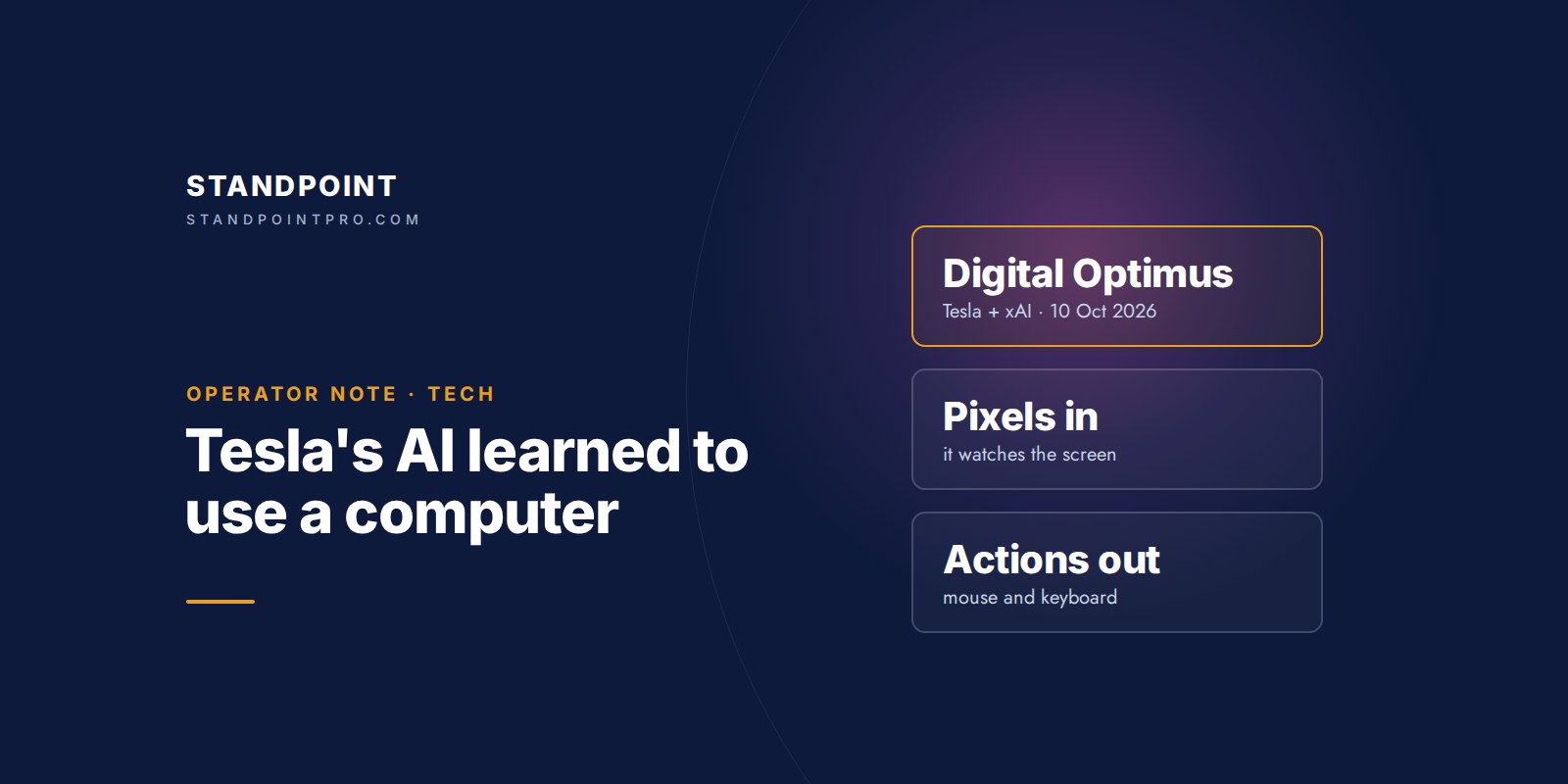
Digital Optimus is a joint Tesla and xAI project: an AI agent that operates a computer the way a person does. On 10 October Elon Musk posted that it can play “about halfway through the Diablo campaign so far just by looking at the screen like a human.”
- Diablo: about halfway through the campaign, from the screen alone.
- Counter-Strike and other fast games: “good”, in his words.
- League of Legends: in training.
- The stated goal: generalise across all games, and from there to any software with a screen.
All of this comes from one post. Tesla has shown no video, no scores and no release date yet, so treat the numbers as Musk’s claims. The method is the interesting part.
How it works: self-driving, but for a screen
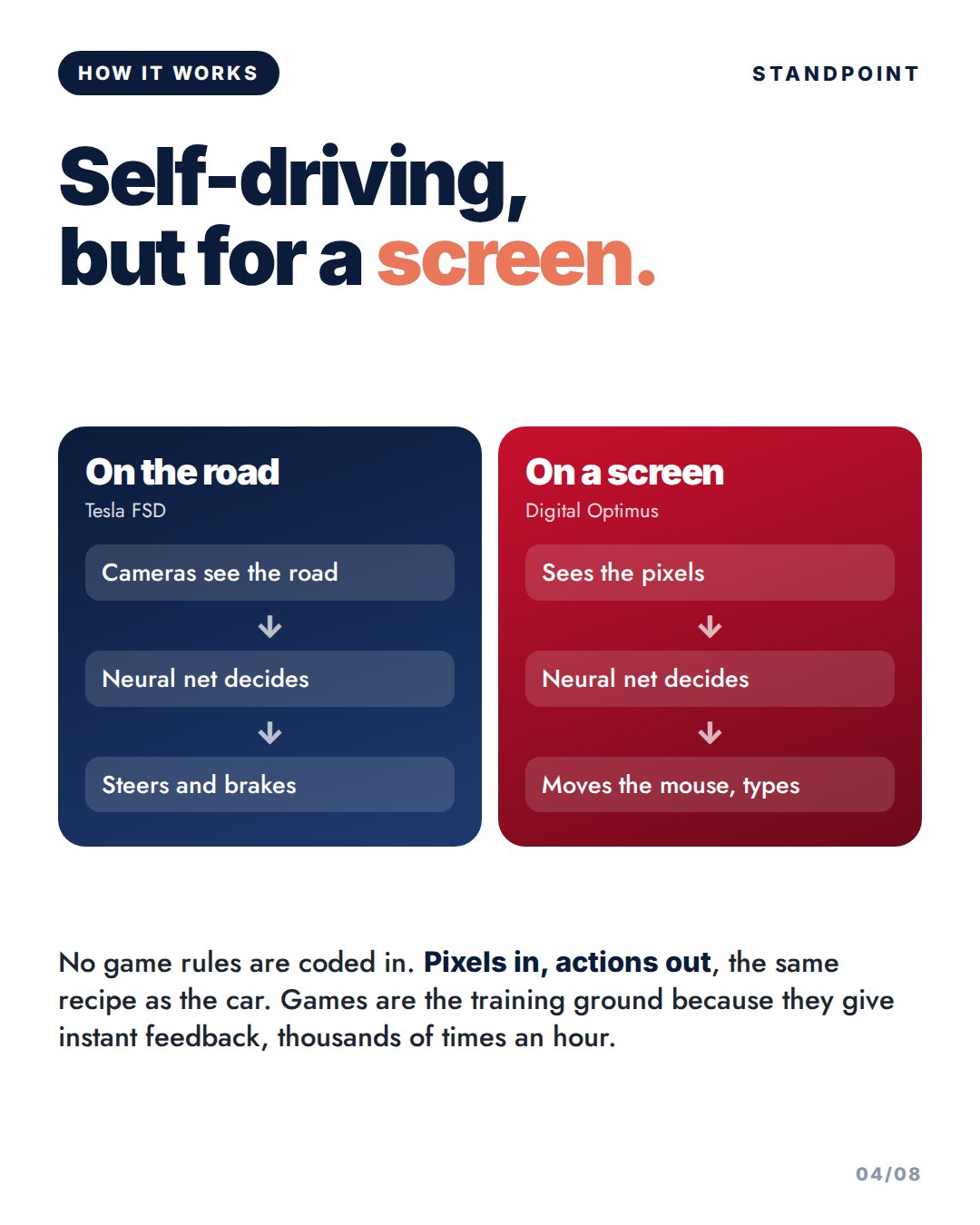
Tesla’s self-driving software takes camera images in and sends steering and braking out. Nobody writes a rule for every road. Digital Optimus uses the same recipe on a computer: pixels in, mouse and keyboard actions out. Nobody codes the game rules into it either. It looks, decides and acts.
Games are the training ground because they give instant feedback thousands of times an hour: you either got past the monster or you didn’t. That makes them a fast way to teach a system to read a screen and act on it.
The hardware: the car’s own chip
Musk says Digital Optimus runs mostly on AI4, Tesla’s own in-car computer, fitted in Teslas built since 2023 and worth about US$650 of hardware. The work is split between two brains: Grok, xAI’s large model, plans what to do next, and Optimus handles the fast reactions on the small chip. That split is how it can keep up with a fast game without a data centre behind every click.
It’s also the link to the rest of Tesla’s AI news. Tesla and SpaceX are building their own chip complex, Terafab, in Grimes County, Texas, and on 7 October Musk said they will run it themselves. Cheap, home-grown chips are what make an agent like this practical at scale.
Computer-use AI already exists outside Tesla
Tesla didn’t invent the idea. ChatGPT, Claude and Copilot each have an agent today that works on a normal laptop the same way: it looks at the screen, clicks and types. Typical jobs:
- Sort an inbox and draft the replies.
- Fill forms and move data between two apps that don’t talk to each other.
- Book, follow up and keep a CRM up to date.
What would be new from Tesla is doing it on a small, cheap chip at game speed, with the same kind of network that drives the car.
What’s not proven yet
- No demo. One post, no video, no date. “Halfway through Diablo” is Musk’s number.
- Games are easier than work. A game has clear goals and an instant score. Email and spreadsheets have neither.
- Mistakes cost more on real software. Today’s agents work best with one app and a job you can check in a minute.
The flying car is the part that’s coming. Software that operates other software is the part that’s already here, and it’s getting cheaper. We’ll update this note when Tesla shows a video.
Checked 17 October 2026. Tesla and xAI claims are reported as stated, not independently verified. Brand names belong to their owners.
Sources: TeslaNorth: Digital Optimus and Diablo, TechCrunch: Roadster reveal, NBC News: flying Roadster, Electrek: Digital Optimus joint project, TeslaNorth: Terafab, Electrek: Terafab site.
Want one short note like this a month?
Practical notes on AI, e-commerce and growth, from businesses we run. No spam. Unsubscribe anytime.