Food Squishies: a passing fad, or a brand worth building?
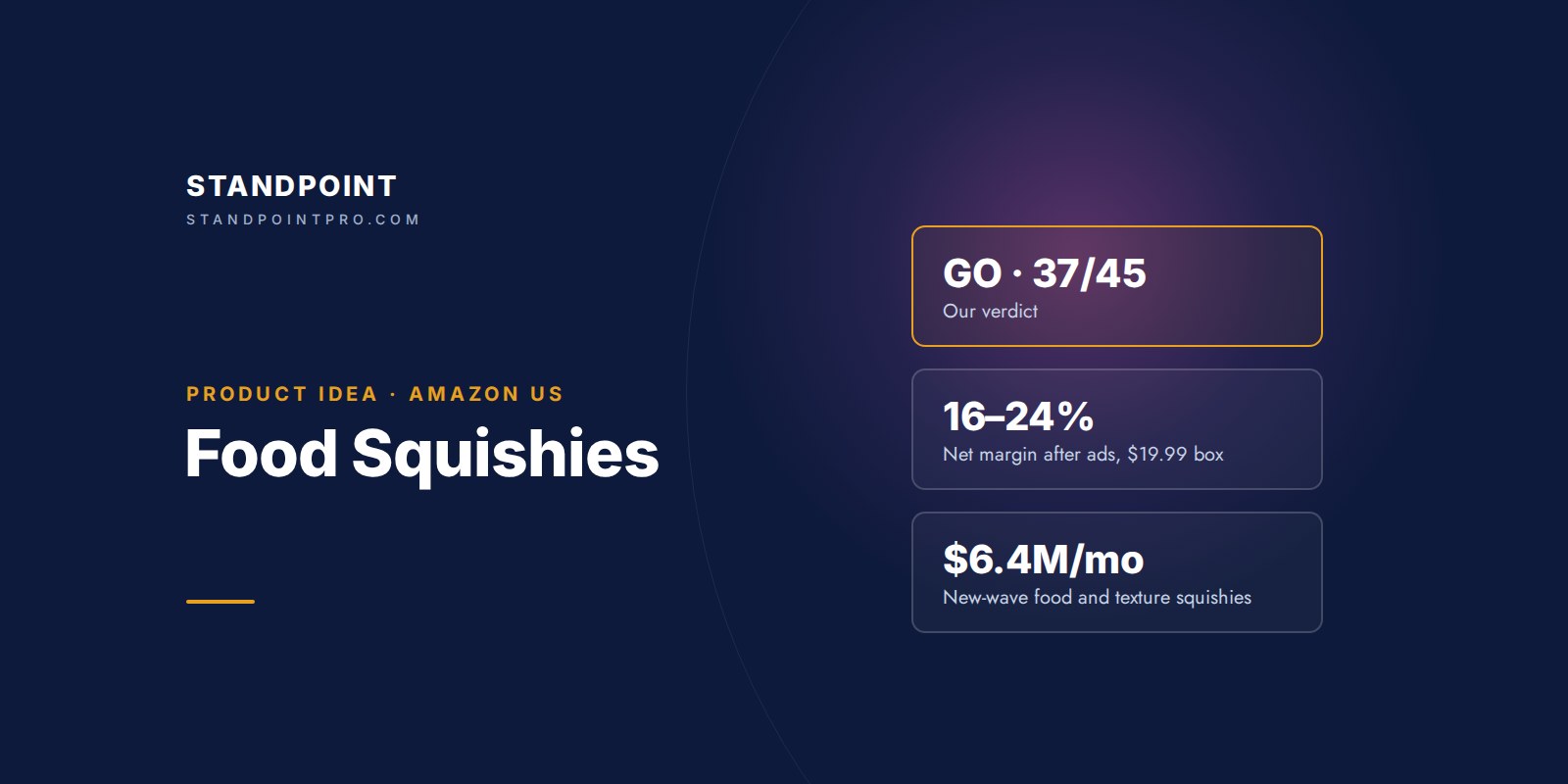
A GO, scored 37 out of 45. Realistic food and new-texture squishies now make up 51% of page-1 sales in the squishy category on Amazon US, about $6.4M of $12.5M a month. The market moves in fast waves, and its best sellers are poor products that leak, smell and break. The way in is a quality-tested $19.99–$24.99 multi-food mystery box, not a cheap $9.99 single: about 16% net margin after ads at launch, and 24% once mature.
How we judged it
We judged it the same way we judge every product: five questions, all answered from real Amazon and Helium 10 data (as of 1 September 2026).
- 1Demand. “dumpling squishy” gets 605,719 searches a month, the biggest term in the category. The wave has moved from shapes to textures: “crunchy squishy” is up 75%.
- 2Market. About $12.5M a month on page 1 across 576 listings. New-wave food and texture squishies are $6.4M of it, 51%.
- 3Competition. Crowded but beatable. 76% of listings launched in 2026, and no seller in butter, cheese, crunchy or coconut oil has more than 1,000 reviews.
- 4Customers. The top cheese squishy sells 13,309 a month at 2.4★. Wrong size, leaks, photos that don’t match and smell cause 53% of returns. That is the gap to win on.
- 5Margin and compliance. A $9.99 single keeps about 4% after ads at launch; a $19.99 box keeps 16%, then 24%. Toy-safety certification is routine, and needed before the first order.
Why GO, and on what conditions: the demand is huge and nobody owns it, and shipping is easy. GO holds on three conditions: sell a multi-food box rather than a cheap single, pass a strict quality test, and move fast, because textures change every few months. The full analysis shows how.
What’s inside the full analysis
Every number behind the verdict, with charts, in plain language, and the method for technical readers.
- 01The verdict and the three conditions
- 02Demand: what people search for
- 03Market size: the classic market and the new wave
- 04Six sub-niches, one by one
- 05What customers say
- 06Unit economics and advertising
- 07How the waves work, timing and compliance
- 08Risks and a nine-point scorecard
- 09The path to launch
- 10How this analysis was built
Common questions
What does GO mean?
The demand, margins and logistics justify entering, but only in the right format. Here GO depends on three conditions: a $19.99+ multi-food box as the main product, a quality test the samples must pass, and speed, with small orders sent by air and new designs as textures change.
Are food squishies just a fad?
The first wave is fading in search (dumpling −12%, cheese −13%), but the food form keeps coming back in new textures, and last year’s taba wave still sells about $1.39M a month at 4.24★. The plan is built on a multi-food box and quality, not on one viral shape.
Where does the data come from?
Amazon US listings and Helium 10 data for sales, reviews, prices, fees and keyword volumes, as of 1 September 2026. Sales figures are estimates. Our own assumptions, like product cost, ad cost and returns, are marked in the report.
Why are competitor names hidden?
We analyse the market, not other sellers. Sellers are described by product type and launch month instead of by name. Every number is kept as measured.
Can I use this analysis for my own launch?
Yes, as a starting point. It is general information, not financial, legal or regulatory advice. Toys need safety testing, so check with a qualified lab before you order stock.
How often do you publish product ideas?
We add new product ideas to Insights regularly, each with the same method and a free full report.
Picking the product is step one. See how we take a product from idea to a growing marketplace brand on our marketplace growth page.
Want an analysis like this for your product? Start with a strategy call →
15 minutes. Free. No pitch.
Get the full analysis
17-page PDF · Free · Opens right after.
Your details stay with us. No newsletter unless you tick the box.