How do you get qualified B2B leads without a sales team?
You get qualified B2B leads from a system, not a list. Choose the market, list the companies that fit, find the people who decide inside them, start a real conversation on LinkedIn, email and phone, and sort the replies before they reach your calendar. It replaces the prospecting part of a sales job, so a small team can run it, in its home market or in a new one.
What is a qualified B2B lead?
A lead is a name and an email address. A qualified lead is a person at a company that fits what you sell, who has replied, has a reason to talk and can influence the decision. Only the second kind deserves a place on your calendar. Bought lists, mass emails and appointment setters usually produce the first kind.
How do you get qualified B2B leads without a sales team?
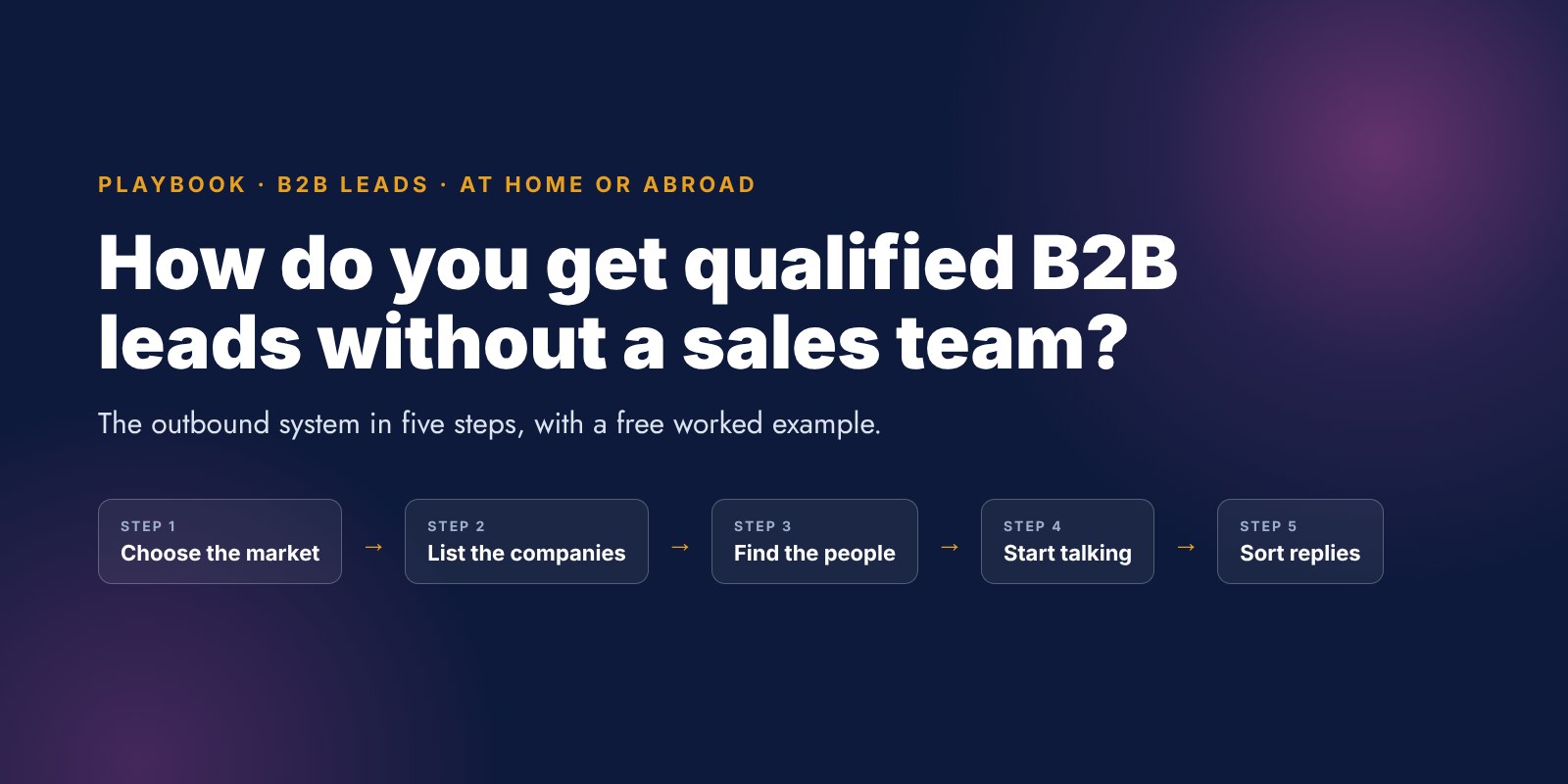
With an outbound system that runs in five steps, in this order. Each step depends on the one before it.
- 1Choose the market. In your home market this is one line: which region or industry first. In a new country it is the key decision: can the buyers be found, can they be contacted under local rules, and can you work in the language?
- 2List the companies. Write down who buys, then build a list of companies that fit, each with a reason it is on the list and a trigger that makes now a good time.
- 3Find the people who decide. In each company: the person who feels the problem, the one who holds the budget and the one who signs off technically.
- 4Start the conversation. LinkedIn, email and phone as one sequence over three to four weeks, written for one person, sent in your name, stopping the moment someone replies.
- 5Sort the replies. A short scorecard (fit, authority, need, timing, budget) separates real interest from politeness. Only the real ones become meetings.
What does this look like for a real business?
The free guide follows a sample company through every step. It is not a client: it stands for any B2B company with a technical product, a home market that knows it, and a next market that does not.
It starts with a few English-speaking markets where buyers are easy to find, lists factories with a reason to write now, finds three people in each, and runs one conversation across LinkedIn, email and phone. Swap factories for hospitals, law firms or software teams and the steps stay the same. If you are not going abroad, skip the first step: the other four are exactly what a company needs when referrals slow down at home.
Is cold outreach allowed in other countries?
The rules depend mainly on where the person you contact is, not where you are, and they differ by country. Canada’s anti-spam law is strict about commercial email, so Canadian outreach usually starts on LinkedIn. The UK and EU expect a clear reason to contact, a relevant message and an easy opt-out. Careful teams everywhere contact people in their work role, say who they are, put an opt-out in every email, stop at once when asked and keep a record of each contact.
This is general information, not legal advice. Rules change; have your message wording and process checked for each market before you start.
What does it take from your side?
One person who knows the product, about two hours a week, to approve the buyer map, check messages and take the first calls. Fast answers to warm replies. And your own accounts: the CRM, LinkedIn Sales Navigator and the email tool should be in your company’s name, so the lists and the data stay with you. The first meetings usually come within weeks; a steady pipeline takes months of adjusting lists and messages.
What’s inside the full guide
The whole system, shown on a sample company going from one market to three continents, with a worksheet to build your own version.
- 01Why referrals and lead lists stop working
- 02The system on one page
- 03Choosing your first markets
- 04Building the list and the buyer map
- 05Finding the three people who decide
- 06Example sequence and messages
- 07The rules by country, in plain words
- 08The reply scorecard and a worksheet
Common questions
How long until the first qualified meeting?
There is a setup period for the market choice, the list, the research and the messages. After that, the first meetings usually come within weeks, and the pipeline grows as lists and messages are adjusted on what the replies say.
Is buying a lead list a shortcut?
A list is a starting point at best. The value is in choosing the right companies, finding the right people, writing a message worth answering and sorting the replies, which a list does not include.
Can a small team find buyers in another country?
Yes, if it starts narrow. Two or three first markets where buyers can be found and business runs in a language the team works in, then more markets once the first ones are running.
Should we hire a salesperson first?
Often not. A salesperson spends most of their first months prospecting. A working outbound system gives them real conversations from day one, or lets the founder take the first meetings before hiring.
Do we keep the system if we stop working with a partner?
You should. Build it in your own CRM, inboxes and LinkedIn accounts from the start, so the lists, sequences and data stay with your company.
Building and running this system with you is how we help companies get qualified B2B leads, at home or abroad. You can run it yourself, or we run it alongside your team and hand it over when you are ready.
Want this applied to your business? Start with a strategy call →
15 minutes. Free. No pitch.
Get the free guide
15-page PDF · Free · Opens right after.
Your details stay with us. No newsletter unless you tick the box.